

IoMT Devices for Remote Patient Monitoring
How connected medical hardware makes remote care more clinically useful.
IoMT devices support remote patient monitoring by giving clinicians access to structured vitals, digital auscultation, visual assessment, longitudinal trends and care-context data during appropriate virtual care workflows.
Why IoMT matters in remote care
Remote care becomes more useful when clinicians can review objective clinical context rather than relying only on conversation. IoMT devices can support that context by capturing structured measurements, recordings, images or longitudinal signals that help inform clinician-led review.
In the Ambulant+ model, IoMT does not replace clinical judgement. It strengthens remote consultation, remote monitoring and care continuity by allowing selected clinical data to move into the care workflow where the patient, clinician and programme rules permit it.
The four-device Ambulant+ scope
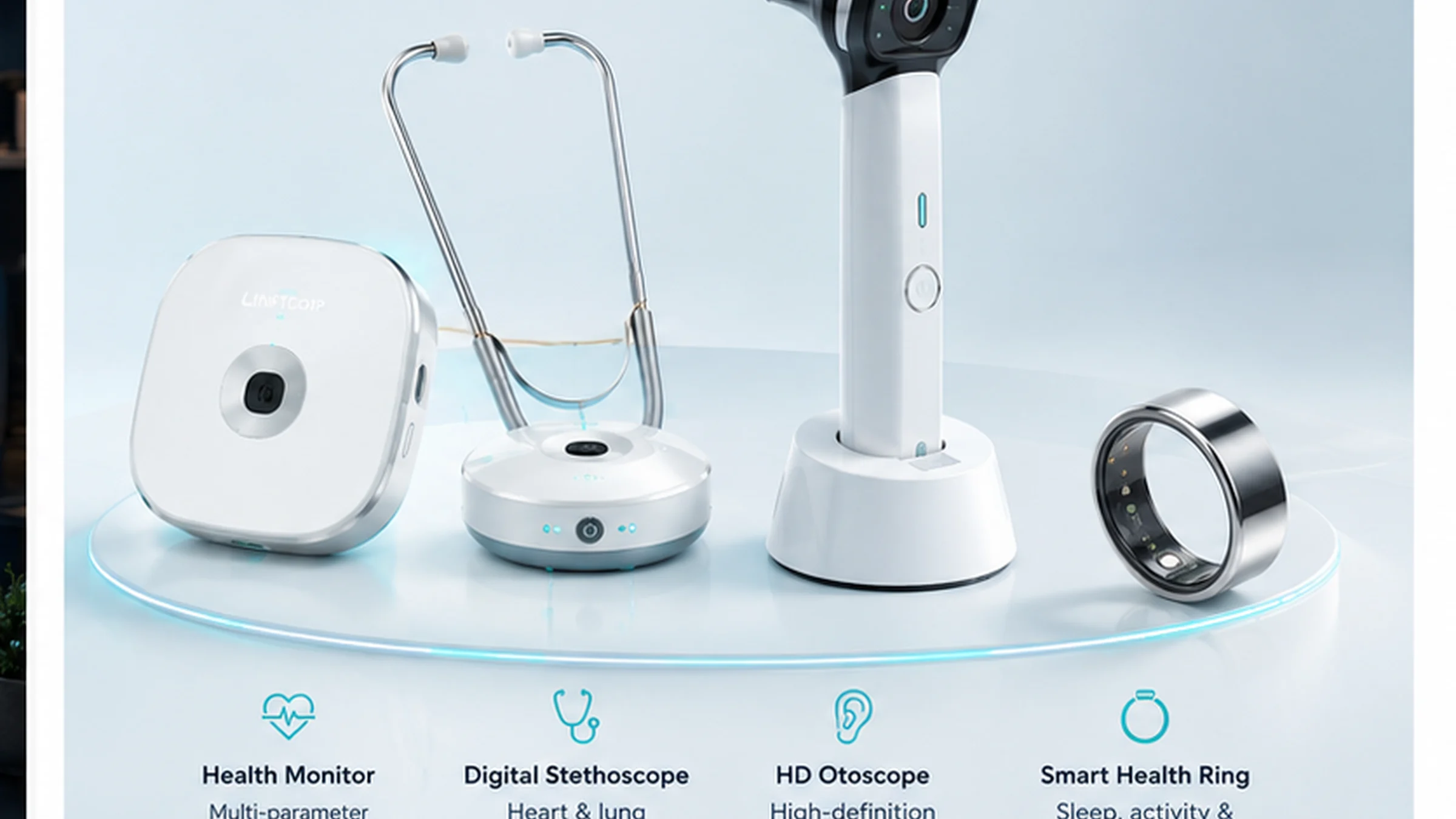
Ambulant+ focuses on a defined device scope rather than an uncontrolled wearable marketplace. The core supported devices are Health Monitor, Digital Stethoscope, HD Otoscope and NexRing.
This keeps the platform clinically disciplined. Each device has a clear role: vital-sign capture, digital auscultation, selected visual assessment or longitudinal wellness context.
Health Monitor supports remote vitals workflows such as blood pressure, SpO₂, temperature, glucose, heart-rate and ECG context where configured.
Digital Stethoscope supports heart and lung sound capture for clinician review.
HD Otoscope supports selected ear and visual-assessment image workflows.
NexRing supports sleep, activity, readiness and temperature-variation context.
Remote monitoring is not just one reading
A single reading can be useful, but the real value often appears in trend context. Repeated blood pressure readings, glucose patterns, oxygen saturation trends, sleep signals, activity behaviour and adherence behaviour can tell a stronger story than an isolated value.
This is why IoMT should sit inside a governed workflow. The data needs context, thresholds, review boundaries, escalation rules and documentation. Without that, device data can become noise.
What funders and care teams can gain
Medical aids, HMOs, employers and clinical networks can use IoMT-supported workflows to improve preventive care, chronic-disease monitoring and earlier risk detection.
The value is not merely that a patient owns a device. The value is that the right signal can reach the right care pathway early enough to support action.
Earlier risk visibility for chronic-care members.
Better preparation before virtual consultations.
More accountable care-plan follow-up.
Stronger basis for preventive-care rewards and funded monitoring programmes.
What does IoMT mean?
IoMT means Internet of Medical Things. It refers to connected medical devices and related systems that can capture or transmit health data into a clinical or care-management workflow.
Are IoMT devices the same as consumer wearables?
Not necessarily. Ambulant+ focuses on defined device-supported care workflows rather than generic wearable integrations.
Can IoMT devices diagnose patients automatically?
No. IoMT devices provide clinical context. Diagnosis and treatment decisions remain clinician-led and must follow appropriate professional and regulatory standards.