

What Is Contactless Medicine?
The next step beyond video-only telemedicine.
Contactless Medicine is a clinician-led model of remote care that combines virtual consultation, connected medical devices, home diagnostics, medication fulfilment and governance-aware clinical intelligence.
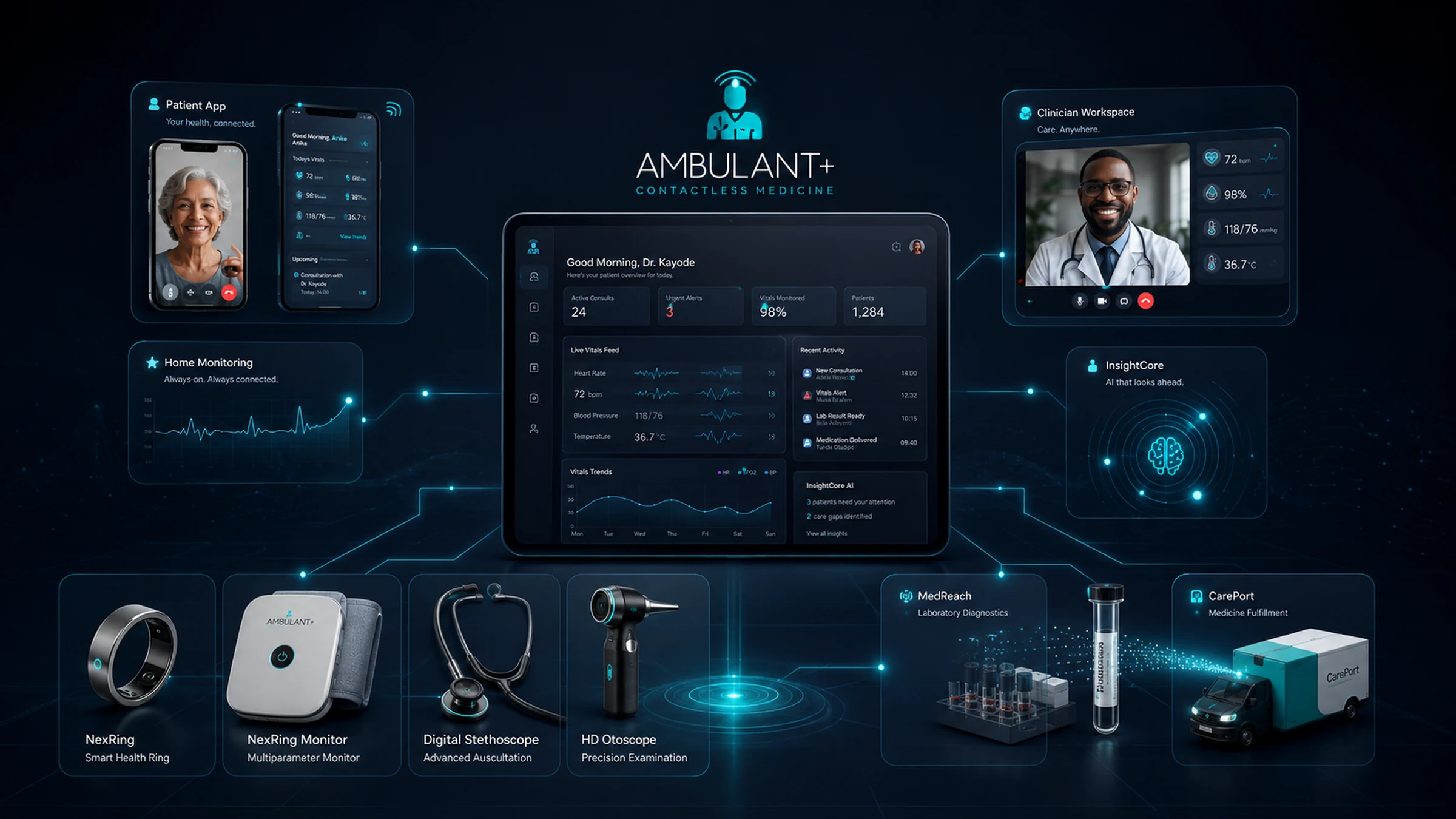
Contactless Medicine, defined simply
Contactless Medicine is remote healthcare supported by the clinical inputs that ordinary video calls often miss. It combines clinician-led virtual consultation with connected medical devices, structured patient information, home diagnostics, medication continuity and governance-aware intelligence.
In practical terms, Contactless Medicine aims to make remote care more complete. The patient is not merely describing symptoms over a video call. Where appropriate, the clinician may also review vitals, device readings, digital auscultation, otoscopy images, medication adherence context, diagnostic requests, prior records and care-pathway history.
Why ordinary telemedicine is not enough
Traditional telemedicine solved a major access problem by allowing patients and doctors to speak without travelling. That matters. But video-only telemedicine can still leave important gaps: no live vitals, no structured device context, no auscultation, no otoscopy, no integrated diagnostics, no pharmacy fulfilment, no adherence scoring and no programme-level visibility for funders.
Those gaps are especially important in chronic disease, post-discharge follow-up, elderly care, family care, fertility pathways and medical-aid funded preventive programmes. In these settings, the real question is not simply whether the patient can speak to a doctor. The question is whether the care system can detect risk early, act quickly, maintain continuity and document what happened.
Video alone may not show blood pressure, oxygen saturation, glucose, temperature or ECG context.
Patient self-reporting may miss objective signs of deterioration.
A prescription is not the end of care if the patient never receives or takes the medicine correctly.
Funders need visibility into outcomes, adherence, utilisation and risk movement.
The Ambulant+ Contactless Medicine model
Ambulant+ brings the missing layers into one governed ecosystem. The platform connects patients, clinicians, supported devices, MedReach diagnostics, CarePort fulfilment and InsightCore intelligence.
The supported device model focuses on four device categories: Health Monitor, Digital Stethoscope, HD Otoscope and NexRing. Together, these can support remote vitals, digital auscultation, selected visual inspection, longitudinal wellness context, readiness, sleep, activity and temperature-variation signals where configured and appropriate.
Health Monitor: blood pressure, SpO₂, temperature, glucose, heart-rate and ECG workflow context.
Digital Stethoscope: heart and lung sound capture for clinician review.
HD Otoscope: selected imaging workflows for ear and visual review.
NexRing: sleep, activity, readiness and temperature-variation context.
Contactless Medicine is still clinician-led
The technology does not replace professional judgement. Device readings, self-checks, dashboards and AI-supported insights must remain part of a clinician-led and governance-aware care pathway.
The point of Contactless Medicine is not to pretend that every physical consultation can be replaced. The point is to make remote care safer, more informative and more operationally complete when remote care is appropriate, while preserving clear escalation to urgent, emergency, specialist or in-person assessment when required.
Who benefits from Contactless Medicine?
Patients benefit from easier access, reduced travel friction, better preparation and continuity. Clinicians benefit from richer context and structured workflows. Medical aids, HMOs and sponsors benefit from preventive-care visibility, adherence signals and claims-ready care events. Pharmacies and laboratories benefit from operational coordination through CarePort and MedReach.
The result is not a simple app. It is an operating layer for remote care, home diagnostics, medication fulfilment and preventive programme visibility.
Is Contactless Medicine the same as telemedicine?
No. Telemedicine is usually focused on remote communication. Contactless Medicine adds supported clinical device context, home diagnostics, medication fulfilment, care continuity and governance-aware intelligence.
Can Contactless Medicine replace emergency care?
No. Contactless Medicine is not an emergency service and should not delay urgent, emergency or in-person care when clinically required.
Does Ambulant+ make automatic diagnoses?
No. Ambulant+ supports clinician-led review. Device data and intelligence layers provide context; they do not replace clinical judgement.