

Contactless Medicine Gives Clinicians a Safer, More Flexible Way to Practise
Remote care is not only a patient access story. It is also a clinician workforce story.
Contactless Medicine can help clinicians practise more flexibly, reduce unnecessary exposure, support remote consultation and remain clinically useful through connected medical devices.
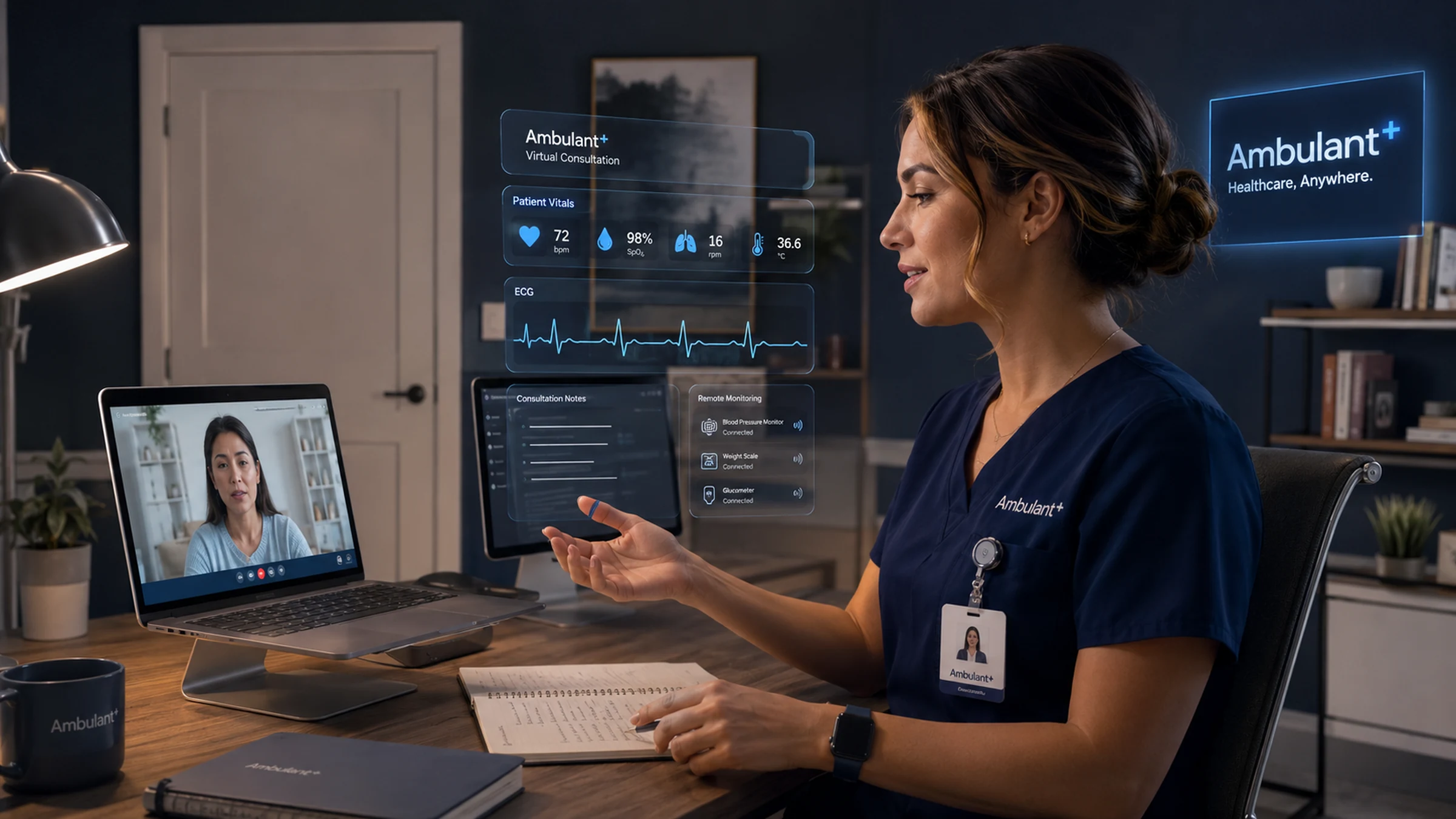
Remote care is also a clinician workforce solution
Most conversations about telemedicine focus on patients. That is important, but incomplete. Clinicians also need safer, more flexible and more sustainable ways to practise.
Some clinicians want better work-life balance. Some are semi-retired but still clinically valuable. Some live far from traditional practice sites. Some have health vulnerabilities or high-risk family members. Some want to serve patients across regions without building a physical clinic in every location.
The problem with video-only remote work
A clinician can talk to a patient by video, but many clinical questions need more context. Without vitals, auscultation, device data, diagnostics, medication history and structured notes, remote work can feel limited.
Ambulant+ is designed to make remote practice more clinically useful by connecting clinicians to device-supported workflows, patient context, CarePort medicine fulfilment, MedReach diagnostics and InsightCore intelligence.
Reducing unnecessary exposure
Clinicians face repeated exposure to respiratory infections and other communicable conditions. This is part of healthcare, but not every patient interaction requires physical proximity.
Where remote care is suitable, Contactless Medicine can reduce unnecessary exposure while preserving access, documentation and escalation.
Who may benefit from this model?
The model can support many clinician groups: GPs, specialists, part-time clinicians, after-hours clinicians, clinicians returning from leave, clinicians with mobility limitations, clinicians in smaller towns and clinicians who want to support broader geographic access.
The opportunity is not to remove clinical responsibility. It is to give clinicians better infrastructure to practise responsibly from more settings.
Private home-office consultation where privacy is protected.
Remote review with supported IoMT device data.
Flexible availability and controlled appointment scheduling.
Clinical documentation and follow-up planning.
Escalation boundaries and governance-aware workflows.
Professional responsibility remains central
Contactless Medicine does not remove professional responsibility. Clinicians must still practise within competence, follow regulatory obligations, recognise red flags and escalate when in-person care or emergency assessment is needed.
The strongest version of remote care is not casual. It is governed, documented, clinically disciplined and supported by the right tools.
Can doctors work remotely with Ambulant+?
Ambulant+ is designed to support clinician-led remote consultation workflows where appropriate, including device-supported review and structured documentation.
Does Contactless Medicine reduce clinician exposure?
It can reduce unnecessary exposure in suitable cases by allowing selected consultations and follow-up to occur remotely.
Does remote practice remove clinician responsibility?
No. Clinicians remain responsible for safe practice, documentation, escalation and professional judgement.