

Why Telemedicine Alone Is Not Enough for Chronic Disease Management
Video calls can open access, but chronic care needs objective data, continuity and escalation.
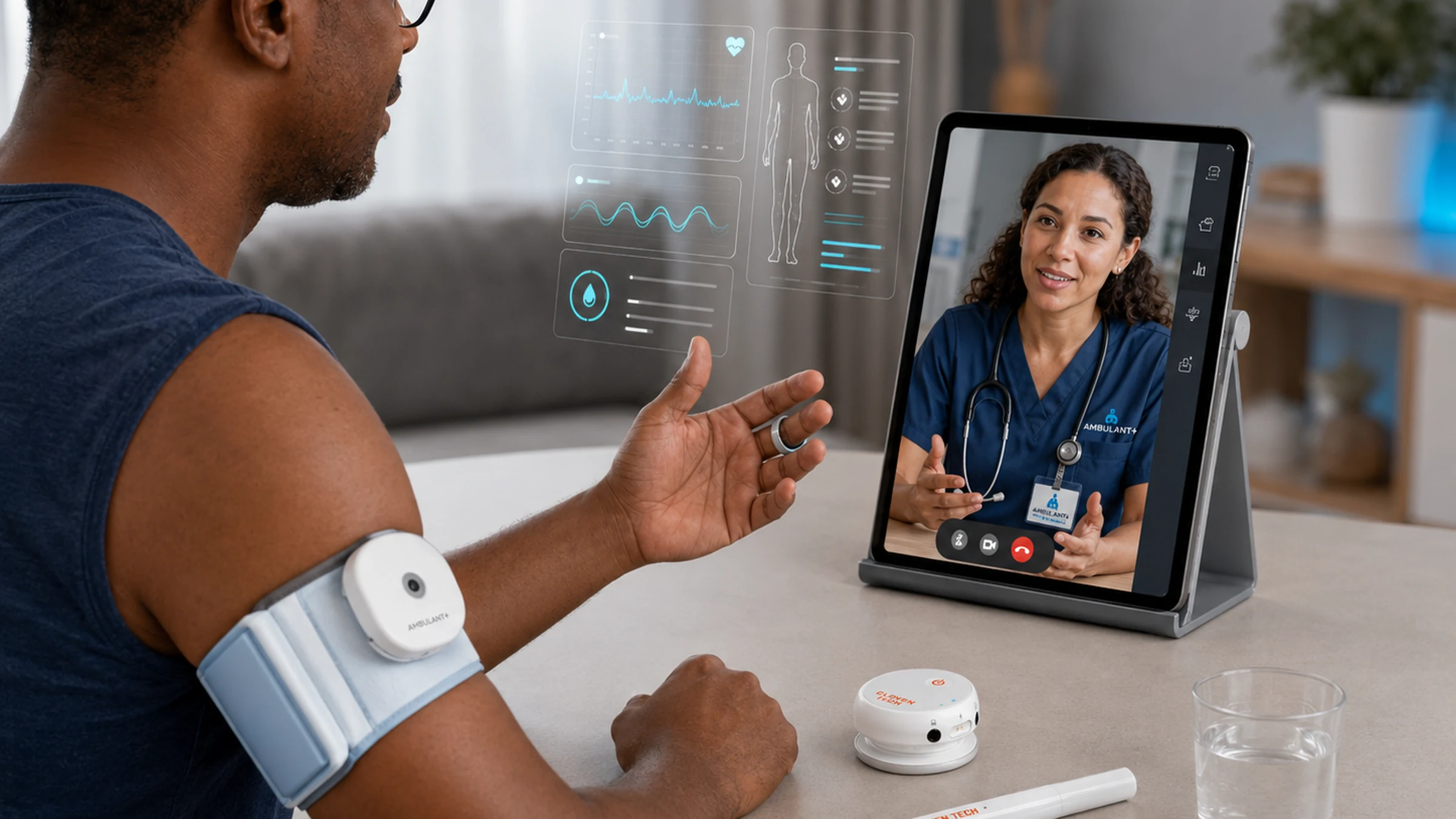
Telemedicine improves access, but chronic disease management needs more than video consultation. Ambulant+ combines remote monitoring, connected medical devices, adherence workflows, home diagnostics and clinician-led review to support better chronic-care continuity.
Telemedicine opened the door, but chronic care needs more
Telemedicine made it easier for patients to speak to clinicians without travelling to a consulting room. That is important, especially for patients who live far from care, depend on others for transport, work irregular hours or have mobility limitations.
But chronic disease management is not solved by access alone. Hypertension, diabetes, asthma, COPD, heart disease and many long-term conditions do not fail only because a patient cannot reach a doctor. They often fail because the care team cannot see enough between visits.
A video call may capture symptoms and conversation, but it may not capture trend, adherence, deterioration, refill gaps, sleep disruption, oxygen saturation, glucose movement, blood pressure variability, auscultation findings or whether the patient actually received and used prescribed treatment.
Chronic disease fails between appointments
Many chronic complications develop quietly. A patient may feel well while blood pressure remains uncontrolled. A diabetic patient may miss patterns in glucose variation. A patient with COPD may slowly deteriorate before seeking help. A patient may collect medication late, take it inconsistently or stop because of side effects.
This is why chronic care needs continuity. The care model must help clinicians and care programmes understand what is happening between scheduled consultations, not only what the patient reports during a short appointment.
Ambulant+ is designed around that gap. It supports clinician-led virtual care, remote vitals, connected-device workflows, home diagnostics, CarePort pharmacy fulfilment, MedReach diagnostics and InsightCore programme intelligence.
What video-only care cannot see
A video consultation can be valuable, but it has natural limits. The clinician can ask questions, observe the patient and provide advice, but many clinical decisions become stronger when supported by objective information.
For chronic disease, the question is rarely only, “How do you feel today?” It is also, “What has changed over the last week, month or treatment cycle?”
Blood pressure trend, not only one isolated reading.
Medication adherence and refill continuity.
Sleep routine, activity level and recovery signals.
Temperature, oxygen saturation, heart rate and glucose movement where relevant.
Digital auscultation recordings for selected respiratory or cardiac reviews.
Home diagnostic workflow status and result routing where appropriate.
CarePort medicine delivery, proof-of-delivery and prescription continuity.
Contactless Medicine adds the missing clinical layer
Contactless Medicine is not simply a video call with a new label. In the Ambulant+ model, it is a governed care system that combines remote access with connected clinical context.
The patient can consult remotely, but the clinician can also work with supported device data, home diagnostics, medicine fulfilment and follow-up documentation. This turns remote care from a convenience layer into a more complete care pathway.
This is especially important when care is preventive. Early review, early medication adjustment, early investigation and early escalation are far cheaper and safer than late emergency intervention.
Why medical aids and employers should care
For medical aids, HMOs, insurers and corporate sponsors, the financial problem is rarely the routine consultation alone. The major risk is avoidable deterioration: uncontrolled chronic disease, late diagnosis, poor adherence, missed follow-up and preventable complications.
A stronger remote-care model helps identify risk earlier. It can support members before the cost curve becomes irreversible. It can also improve member experience because the patient receives more convenient care without losing clinical structure.
This matters for lifetime value. Healthier members stay productive, engaged and covered for longer. Preventive care is not only compassionate; it is economically rational.
The future is not telemedicine versus in-person care
The strongest healthcare systems will not choose between physical and digital care. They will use each channel for the right purpose.
Some patients need emergency care, physical examination, imaging, procedures or admission. Others need structured remote review, monitoring, medicine continuity, diagnostics coordination or prevention support.
Ambulant+ sits in that practical middle ground: remote where safe and useful, escalated where needed, and always framed around clinician judgement.
Is telemedicine enough for chronic disease management?
Telemedicine can improve access, but chronic disease management often needs remote monitoring, medication adherence visibility, diagnostics, trend review and structured follow-up. Video alone may not provide enough clinical context.
How does Contactless Medicine improve chronic care?
Contactless Medicine adds connected devices, remote vitals, digital diagnostics, medicine fulfilment, adherence workflows and clinician-led review to remote consultation.
Does Ambulant+ replace in-person chronic care?
No. Ambulant+ supports suitable remote care and earlier escalation. In-person assessment remains necessary for emergencies, procedures, physical examination and complex clinical situations.