

How Contactless Medicine Can Protect Care During the Next Pandemic
The post-COVID lesson is clear: isolation should never mean interruption of care.
Contactless Medicine can help preserve clinician-led care during pandemics, outbreaks and infectious-disease surges by combining remote consultation, connected medical devices, home diagnostics, medicine delivery and governed escalation.
COVID-19 exposed the weakness in ordinary healthcare access
COVID-19 taught healthcare systems a painful lesson: when physical movement becomes unsafe, routine care can collapse very quickly. Patients delay consultations, chronic disease monitoring weakens, diagnostic tests are missed, prescriptions are interrupted, clinicians face repeated exposure and vulnerable patients become afraid of visiting clinics or hospitals.
The world learned that healthcare systems need more than emergency capacity. They need continuity capacity. They need a way to keep appropriate care moving even when people must reduce physical contact.
Ambulant+ should be understood partly as a post-COVID-19 response invention: a Contactless Medicine platform built around the idea that isolation should not mean abandonment, and infection control should not mean clinical blindness.
The next threat may not announce itself loudly at first
Pandemic risk does not always begin with a dramatic global shutdown. A new respiratory virus, seasonal surge, resistant infection, regional outbreak or communicable-disease cluster may start subtly. The danger is that healthcare systems often react only after transmission, fear and service disruption are already widespread.
Contactless Medicine gives health systems a more flexible operating model. It allows selected patients to be assessed, monitored, followed up, prescribed for and supported without automatically sending every care interaction into crowded physical spaces.
This does not remove the need for hospitals, clinics, laboratories or public-health intervention. It creates an additional layer of healthcare resilience before, during and after infectious-disease disruption.
Video calls alone are not enough in a pandemic
During a pandemic or outbreak, ordinary telemedicine is useful because it keeps patients and clinicians connected. But a video-only model still has important blind spots. It may not show oxygen saturation, temperature, blood pressure, glucose, heart-rate trends, lung sounds, medication adherence, diagnostic status or deterioration patterns.
That matters because many patients who are isolating still need clinical context. A patient with asthma, COPD, pneumonia risk, hypertension, diabetes, pregnancy-related concerns, elderly frailty or post-discharge vulnerability may require more than conversation.
Contactless Medicine adds the missing layers: remote vitals, digital auscultation, selected imaging, longitudinal monitoring, home diagnostics, eRx fulfilment, medication reminders, medicine delivery, documentation and escalation logic.
Remote vitals can help clinicians review objective signs without immediate travel.
Digital auscultation can support selected heart and lung sound review.
Home diagnostics can reduce avoidable laboratory visits where appropriate.
CarePort medicine fulfilment can protect treatment continuity.
InsightCore can support programme-level visibility and risk movement.
Protecting vulnerable patients without cutting them off from care
In every infectious-disease surge, the same vulnerable groups become especially important: elderly patients, immunocompromised patients, pregnant women, infants, chronic respiratory patients, patients with cardiovascular disease, diabetics and people recovering from recent illness.
These patients may need care more urgently than average, but also face greater risk from unnecessary exposure. Contactless Medicine gives clinicians and care programmes a way to support suitable reviews from home, while still escalating red flags to urgent or in-person care.
The aim is not to keep patients away from hospitals when hospitals are needed. The aim is to prevent avoidable exposure for care that can be safely started, reviewed, monitored or followed remotely.
Protecting clinicians and preserving workforce capacity
Pandemics do not only affect patients. They affect clinicians. Healthcare workers may face repeated exposure, staff shortages, fatigue, family risk, illness, isolation rules and moral pressure to keep services running.
Contactless Medicine can reduce unnecessary clinician exposure by moving suitable consultations, follow-ups and monitoring reviews into a governed remote workflow. This is especially important for clinicians who can still provide high-quality care but should not be repeatedly exposed to infectious environments when remote care is appropriate.
In a future outbreak, the ability for clinicians to work from secure private rooms, home offices, controlled pods or distributed care hubs may become a major healthcare-continuity advantage.
The role of connected devices during respiratory outbreaks
Respiratory outbreaks create a specific problem: patients may need observation, oxygen saturation checks, temperature monitoring, respiratory symptom review and sometimes lung-sound context. A video call alone may not give enough information.
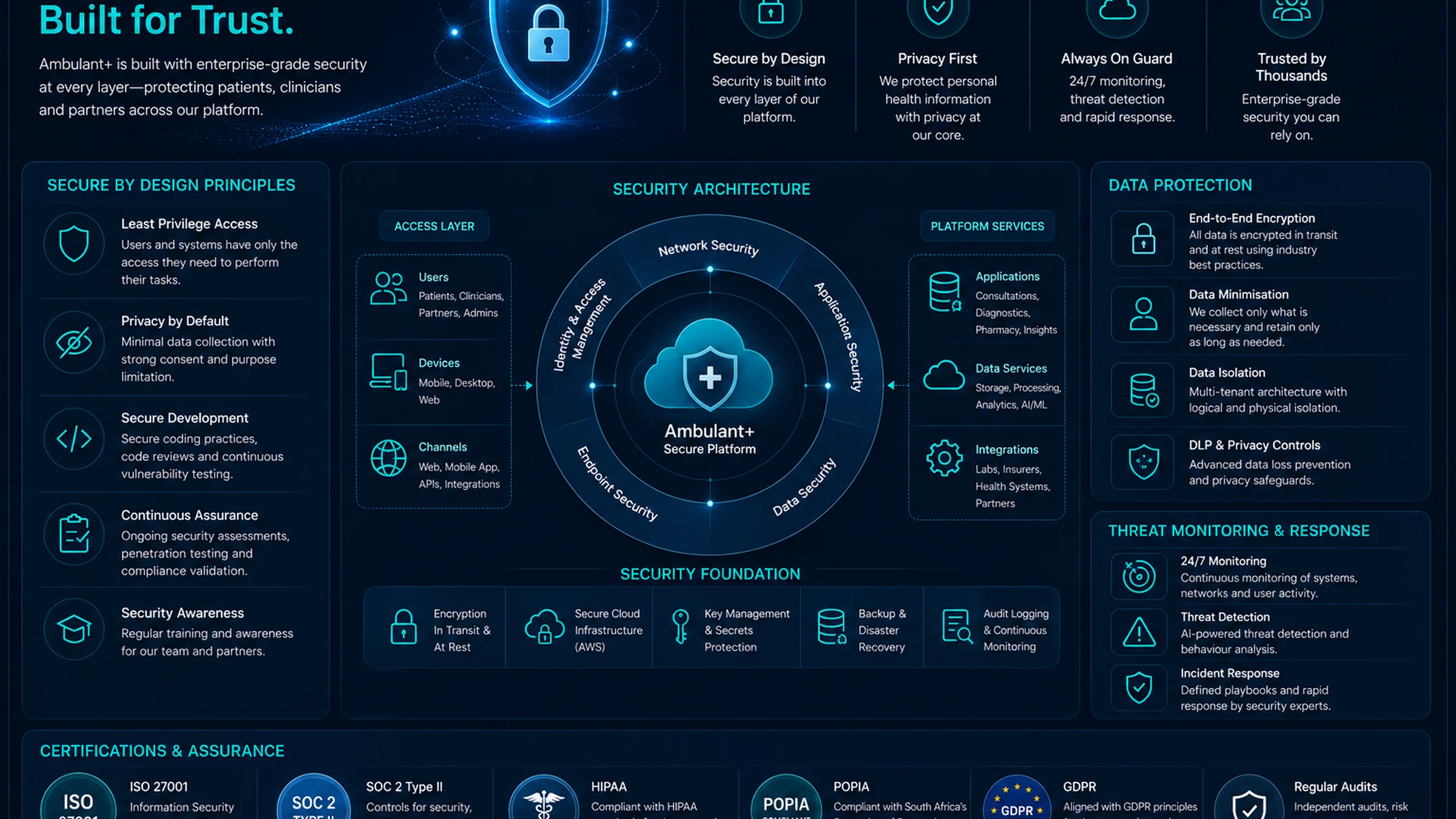
Ambulant+ supports a defined IoMT model through Health Monitor, Digital Stethoscope, HD Otoscope and NexRing workflows. These devices can support remote clinical context where configured and appropriate, without pretending that every examination can be replaced remotely.
For example, a patient with worsening cough or breathlessness may need symptom review, oxygen saturation, temperature, medication history and digital auscultation context. If concerning signs appear, the system should support escalation rather than delay urgent care.
Health Monitor can support remote vitals workflows.
Digital Stethoscope can support selected lung and heart sound capture.
HD Otoscope can support selected visual assessment workflows.
NexRing can support longitudinal signals such as sleep, readiness, activity and temperature variation.
Home diagnostics and medicine delivery reduce avoidable movement
One of the biggest problems during outbreaks is movement. Patients move to clinics, laboratories, pharmacies and hospitals. Caregivers accompany them. Clinicians and support teams move between settings. Every unnecessary movement can become an exposure event.
MedReach and CarePort are strategically important in pandemic-resilient healthcare because they reduce some of that movement. MedReach can support home phlebotomy and laboratory coordination where appropriate. CarePort can support prescription fulfilment, dispatch, proof-of-delivery and medication continuity.
Together, these layers help preserve care without automatically forcing the patient through multiple public contact points.
Medical aids and employers need pandemic-ready care models
Medical aids, HMOs, insurers and employers should not wait for the next major outbreak before building remote-care capacity. During a pandemic, the cost of late intervention can rise quickly: unmanaged chronic disease, delayed diagnostics, missed prescriptions, avoidable admissions and workforce disruption.
A pandemic-ready care model should include remote access, connected monitoring, claims-ready documentation, adherence visibility, home diagnostics, medicine fulfilment and population-level programme intelligence.
This is where Ambulant+ becomes a strategic platform rather than a convenience app. It helps funders and employers preserve continuity of care while reducing unnecessary exposure and avoidable deterioration.
The safety boundary must remain clear
Contactless Medicine should never be described as a replacement for emergency care. During a pandemic, that distinction becomes even more important. Severe symptoms, red flags, rapid deterioration, dangerous oxygen levels, chest pain, collapse, confusion, severe dehydration, uncontrolled bleeding, serious infection concerns and other emergencies still require urgent or emergency assessment.
The correct promise is disciplined and defensible: Contactless Medicine can reduce unnecessary contact, preserve appropriate remote care and support earlier escalation when physical assessment is needed.
That is the mature post-COVID lesson. The world does not only need more video calls. It needs clinically governed, device-supported, operations-ready healthcare continuity.
Can Contactless Medicine help during another pandemic?
Yes. Contactless Medicine can help preserve appropriate clinician-led care during pandemics and outbreaks by supporting remote consultation, remote monitoring, home diagnostics, medication continuity and escalation workflows.
Is Ambulant+ a post-COVID-19 healthcare invention?
Ambulant+ can be positioned as a post-COVID-19 response invention because it addresses the care-continuity weaknesses exposed by COVID-19: physical access disruption, infection exposure, delayed monitoring, missed diagnostics and interrupted medication pathways.
Does Contactless Medicine replace hospitals during pandemics?
No. Hospitals remain essential for emergency, severe and complex care. Contactless Medicine supports suitable remote care and helps escalate patients appropriately when in-person assessment is required.
Why are connected devices important during outbreaks?
Connected devices can add objective context such as vitals, lung sounds, heart sounds, selected images and longitudinal trends, making remote care more informative than video-only consultation.